
Clay County City Directory Shelves
Clay County does not have one complete, year-by-year city directory run. The strongest verified shelf is at the Orange Park Library's Genealogy and Reference department. Its noncirculating reference books include a Polk title for Orange Park and Green Cove Springs, Jacksonville-area Polk editions, and a large address-first series. The catalog count signals substantial coverage, but it hides many item dates. Call staff before traveling and ask them to inspect the item records.
| Collection | Years or edition | Where held | Access |
|---|---|---|---|
| Orange Park and Green Cove Springs city directory | Title says 1975; catalog says 1978 | Orange Park Library, REF 917.591 POL | Noncirculating reference; 13 copies reported |
| Greater Jacksonville cross-reference directory | Individual dates hidden; September 1976 independently confirmed | Orange Park Library, REF 917.591 CRO | Address-first reference; 37 copies reported |
| Jacksonville-area Polk directories | 1993, 1995, 1997-98, 1999, 2000 examples | Orange Park Library | In-person reference shelf |
| Goldmine of Names | 75 transcribed local lists | Clay County Historical Archives | Free online index; originals retrieved by staff |
The library catalog's Polk search is the best way to confirm the current shelf. Its 1975 title and 1978 publication statement conflict, so cite what appears on the book's title and copyright pages rather than silently choosing one year.
The catalog view shows how Clay County city directories are grouped by author and call number.
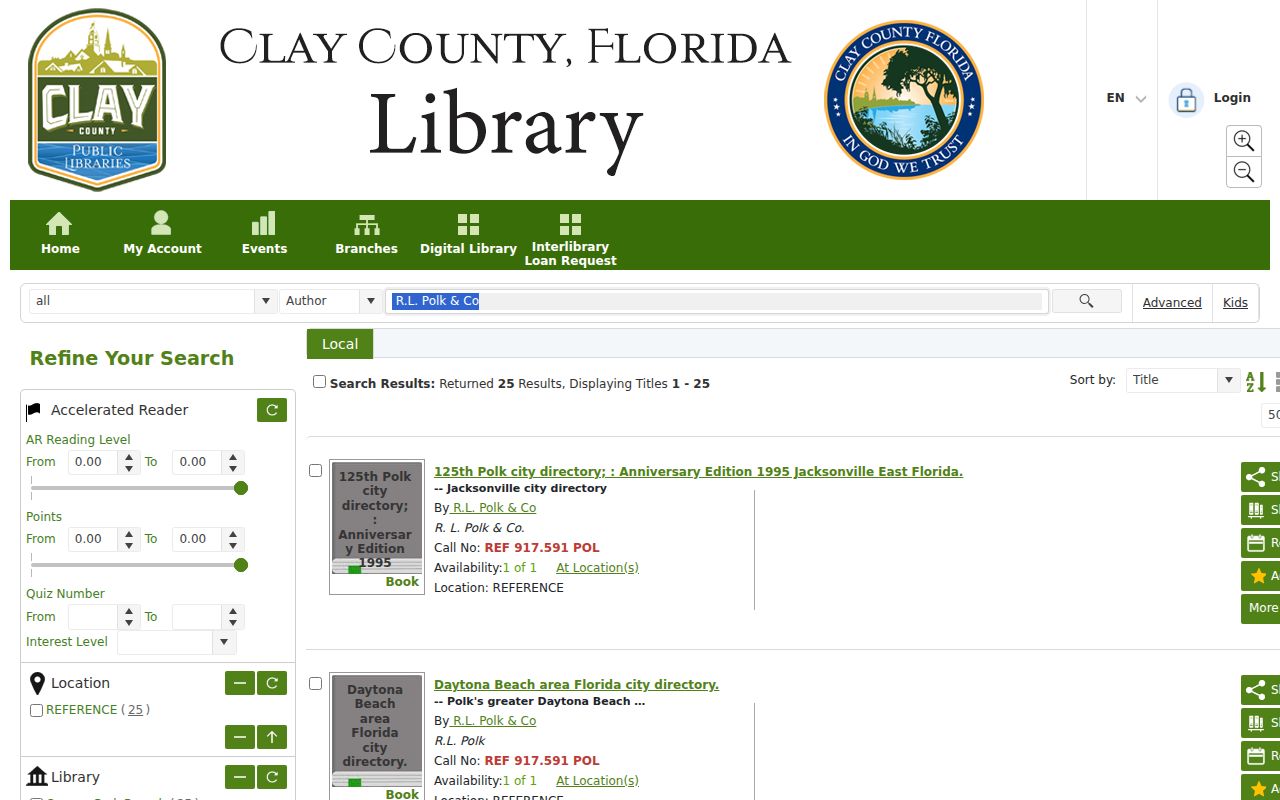
That screen is a starting point, not a substitute for checking the physical edition and its coverage notes.
Clay County Directory Research Desk
Orange Park Library is the system's Genealogy and Reference branch at 2054 Plainfield Avenue. The general line is 904-278-4750, and the genealogy desk is 904-278-4753. Hours are Monday through Thursday, 9 a.m. to 8 p.m., and Friday through Saturday, 9 a.m. to 5 p.m. The books stay in the library. That makes preparation important: bring names, spelling variants, likely communities, and a date range.
Cardholders can also use Ancestry Library and more than sixty Florida Electronic Library databases through the library research collection. Reference holdings include yearbooks, newspapers, microfilm, microfiche, local history, and digital resources. Ask staff which volume covers Orange Park, Green Cove Springs, Middleburg, Penney Farms, or northern Clay County. A Jacksonville title may include Clay communities even when the county name is not prominent.
Note: Confirm shelf dates with library staff because public catalog copy counts do not reveal every volume's year.
Clay County's Goldmine of Names
The Historical Archives built a directory substitute from records that were never city directories at all. Its Goldmine of Names combines 75 transcribed local lists, standardizes surname variants caused by handwriting and spelling, and connects a hit to the original bound record or file. More than 400 person and family subject files add clippings, photographs, oral interviews, and compiled histories.
Search the Goldmine of Names genealogy index before asking the archives for an original. The result can point toward tax, probate, voter, court, cemetery, or other locally held evidence.
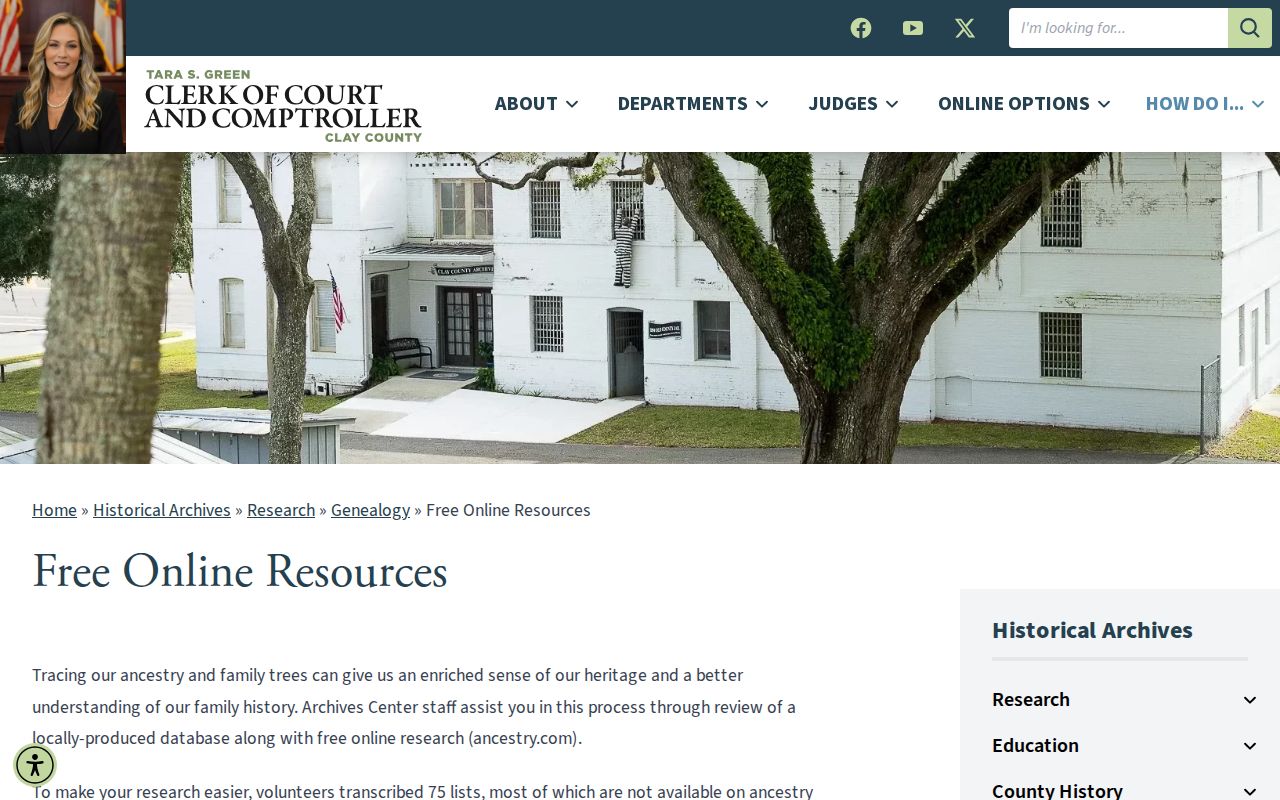
The image shows why the index is useful: it gathers many small name lists without pretending that they form a single resident roll.
African-American family research benefits from indexed sources and the Forrester materials. The archives identifies the Forresters as Clay's only free African-American family in 1860 and records descendant surnames including Lycurgus, Redmond, Lewis, Miller, Lemon, and Stewart. Those aids can bridge gaps that a printed directory leaves behind.
Decode Clay County City Directory Entries
No accessible scan of an ordinary Clay entry was verified. Do not assume that a Polk custom used elsewhere appears here. Request REF 917.591 POL or CRO, copy the title, publication date, coverage statement, and key, then inventory the actual entry. The following fields are inspection targets, not claims about every volume.
| Name | Record the full spelling, initials, and any spouse notation exactly. |
|---|---|
| Work description | Copy an occupation or employer only when the entry prints it. |
| Address | Preserve the house number, street spelling, and any residence or boarding mark. |
| Owner or renter mark | Use it only after confirming the symbol in that edition's key. |
| Phone or widow notation | Treat each as a dated clue that needs support from another record. |
- Criss-cross directory
- An address-first volume or section arranged by street, useful when the address is known but the occupant's name is not.
- Householder index
- A list centered on the person responsible for a household, not a full list of all people living there.
- Abbreviation key
- The edition's guide to shortened words and symbols. Photograph or copy it before interpreting an entry.
Newspapers Extend Clay Directory Years
When a city directory year is absent, newspapers can place a name, shop, estate, or address within a smaller time window. Clay County Historical Archives holds original whole newspapers from 1891 and an index to Florida Times-Union Clay articles from 1885 through 1901. Known local titles include the Clay County Chronicle, Clay County Times, Middleburg Mirror, Clay County Crescent, Breeze, and Clay Today.
The Florida Digital Newspaper Library offers searchable statewide scans. Search surname variants, then pair a notice or advertisement with a dated directory entry. A newspaper mention may reflect a visit, a business address, or a social event rather than a home, so read the full item.
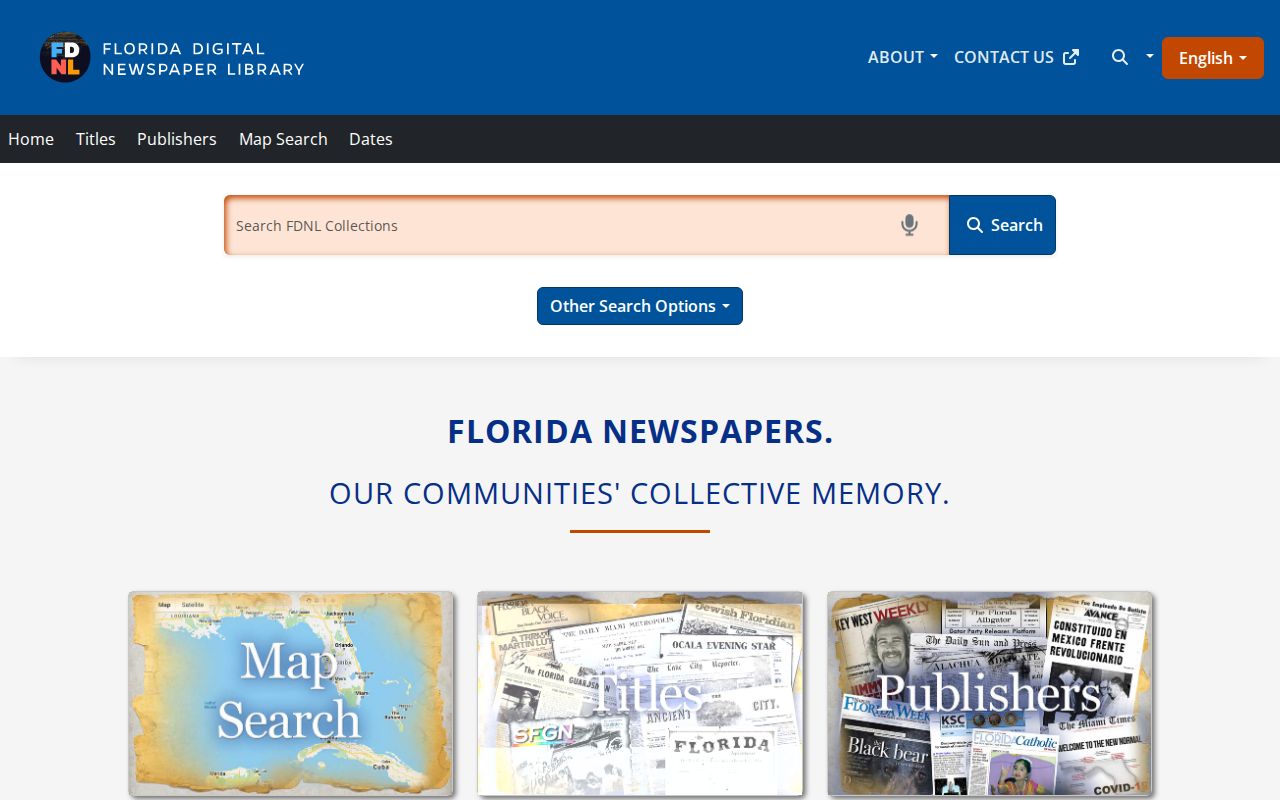
The search interface helps bridge years, but the newspaper page and publication date remain the evidence to save.
Clay County Directory Time Markers
Local record history explains why an apparently thorough name search can still fail. Clay County formed from Duval County at the end of 1858. Records were lost during the 1872 move from Whitesville, after the Civil War and weak local government. The archives describes a partial 1859-72 gap, not a courthouse fire. Earlier residents may appear under Duval County, while later gaps call for substitute sources.
| Period | Research marker |
|---|---|
| Before 1858 | Search Duval County geography and records. |
| 1859-72 | Expect a partial Clay record gap and use newspapers, tax books, and later indexes. |
| 1885 | Verified directory evidence includes a Webb's reference. |
| September 1976 | Greater Jacksonville cross-reference coverage includes Clay communities. |
| 1993-2000 | Catalog examples show Jacksonville-area Polk editions useful for northern Clay. |
Green Cove Springs changed from White Sulphur Springs in 1866, and Keystone Heights was Brooklyn until 1921. Middleburg also appears under older place names. Search both the old and new form, since printed indexes do not translate every place name.
Clay's economy also changed the kinds of listings a researcher will meet. Timber and sawmills, citrus and river tourism, naval stores, cattle and dairy work, Camp Blanding, and the Navy drew different groups at different times. Benjamin Lee Field helped Green Cove Springs grow sharply during the 1940s, and the postwar mothball fleet kept another set of names in local sources. Penney Farms began with J.C. Penney's large land project and kept a distinct town identity after the Depression. These facts do not identify a person by themselves, but they help explain why an occupation, business name, or short stay appears in one edition and not the next.
Pair Clay Directories With Census
A directory gives a dated listing, while a census can name members of the household. The 1950 census is the newest public person-level federal census under the 72-year rule. Schedules from 1850 usually name household members; schedules before 1850 commonly name only heads. Most 1890 population schedules were destroyed nationwide.
Use the National Archives 1950 Census search after a city directory narrows the name and community.
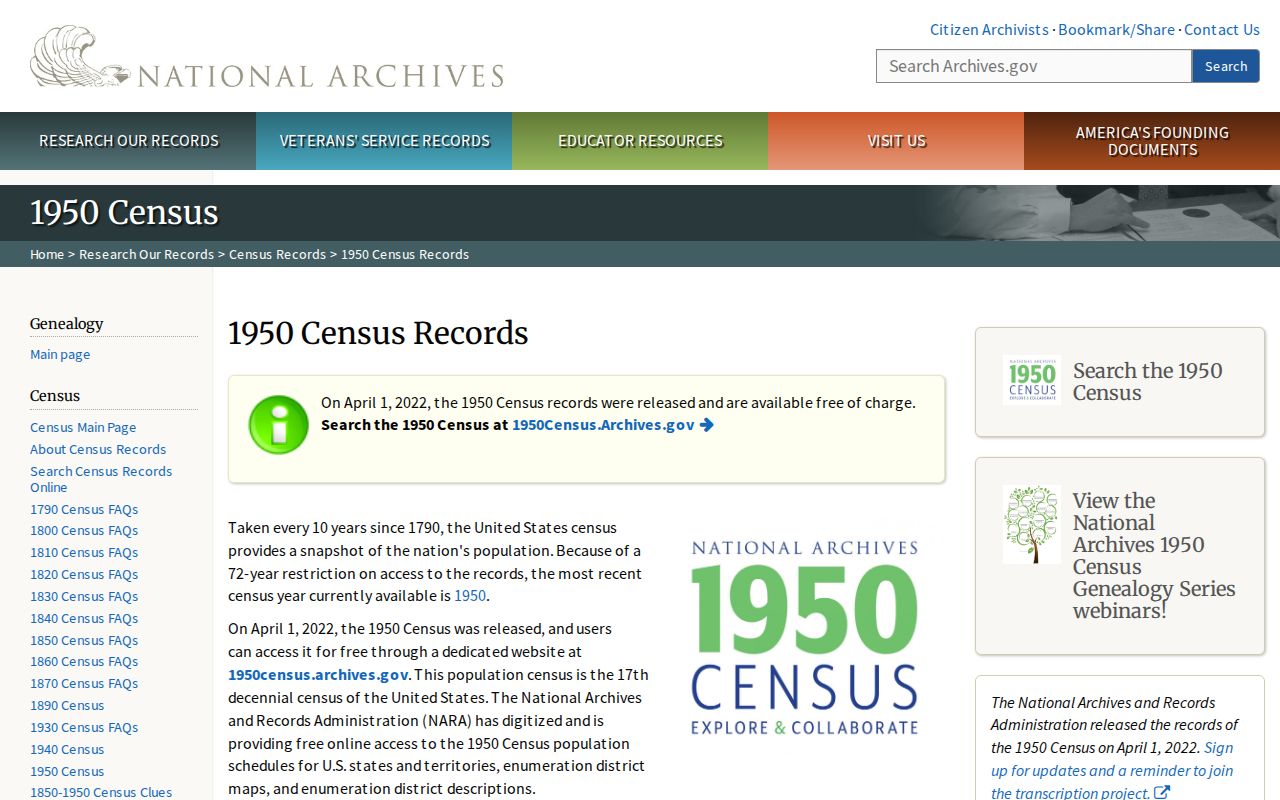
The census can distinguish namesakes through ages, relationships, and nearby households, though each fact still reflects that census date.
The library holds the Index to 1850 Florida Census at REF-GEN 929.3759 IND. Between census years, use tax books, probate files, voting material, and newspapers. The city directory contributes movement by address; the census supplies a periodic household snapshot.
Read nearby names as context, not proof of kinship. A census household may include relatives, boarders, or workers, while a directory may name only one householder. Compare ages, birthplaces, relationships, and the sequence of addresses. If the two sources disagree, keep both citations and look for a probate file, obituary, tax entry, or later edition that resolves the difference.
Trace Families Through Clay Directories
Follow a household in a set order. Save exact citations as you go, including title, year, page, and call number. A person who vanishes may have moved, died, changed a surname, fallen outside the publisher's coverage, or simply been omitted.
- Find the newest likely Clay County city directory entry and copy it exactly, including abbreviations and marks.
- Move backward one available edition at a time. Track street, spouse, work description, and all name variants.
- Use the cross-reference volume to test the address and see who is listed there in that edition.
- Pair the directory date with a federal census, then use tax, probate, voting, and newspaper records between census years.
- Take unresolved names to the Historical Archives, where staff can retrieve the Goldmine source and person files.
Sanborn maps for Green Cove Springs survive for 1892 and 1897, and the archives holds territorial surveys, land grants, aerials, and plats. They add physical context but do not list every occupant. For current address-keyed records, use the Clay County street directory rather than treating an old listing as present-day proof.
The archives also holds tax books from 1869 through 1960, probate records from 1859 through 1956, and voting material from the 1860s into the 1940s. Staff retrieves secure material at the Old Jail, 21 Gratio Place, on weekdays from 8 a.m. to 5 p.m. Appointments are strongly recommended through 904-371-0027 or clayarchives@clayclerk.com. Ask for the exact series and date range, since the archive is not an open-stack library.